Rasanach
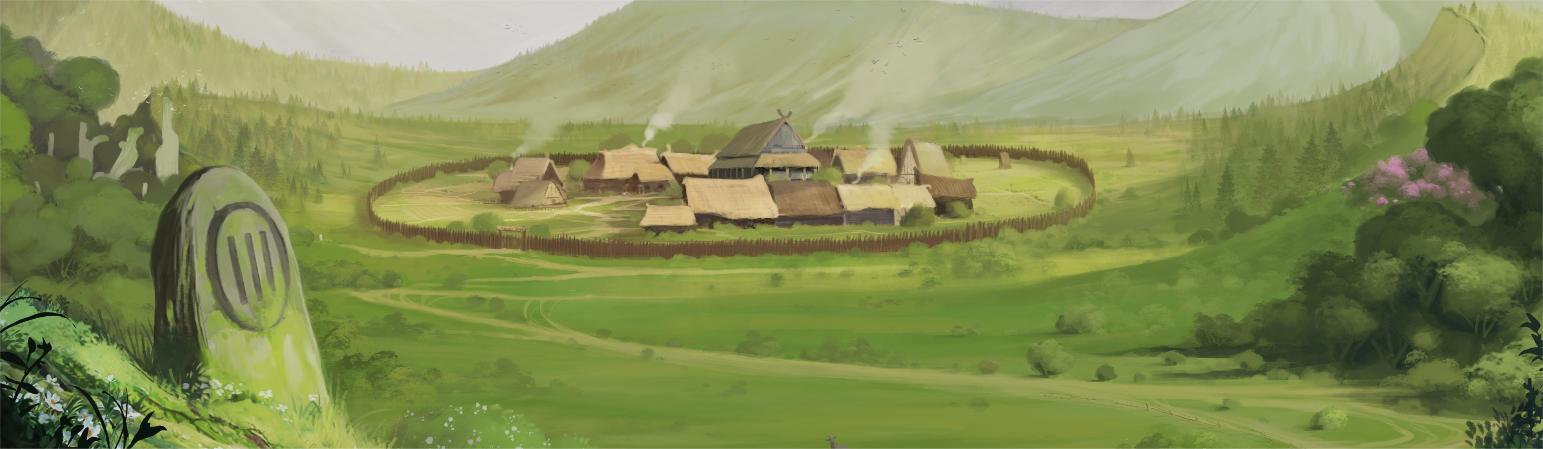
Original Art by Pino44io
Rasanach is a modest highland village nestling in a sheltered valley in the Eastern Hydra Hills with good farmland, ample grazing and an abundance of woods and clean water. The villagers live their quiet lives as swine and goats herds with a cottage industry of dyes and weaving supplementing them. The village consists of a dozen or so building and huts which are all thatched save for the largest hall and shrine of Ernalda. There is a single modest tavern as the village is on the trail up to the Copper and Silver mines to the west. Rasanach is surrounded by a stockade within which the livestock are penned at night and where small vegetable patches are kept. There is ample game in the woods and hills nearby which the villagers hunt.
Away from the village is a copse of pink cherry trees where it is claimed a drop of Flamal’s blood fell after his murder by Zorak Zoran. The seed god’s essence allowed the blushing trees to grow and bloom bringing warmth to the valley where they have flourished ever since. The villagers are respectful of the wild grove and like of the splash of colour it brings to the scenery. They wholeheartedly believe the origin story. Every year on wildday, truth week of storm season the villagers traditionally hold a fayre by the grove and tie bright ribbons to the trees. Folk come from the settlements around to join in much merriment is had. They sing songs and dance to honour Flamal, who was Ernalda’s first husband. The fayre is famed for its good weather and is much beloved by children and adults alike.
On the western side of the valley from the village are the aged ruins of the Cnoc Troich, Dwarf Hill, where local myth explains the Mostali once lived in the ages long past. A carving of a barely visible stasis rune in the crumbling foundations may well be the cause of this fable. The ruins are home to a wide variety of snails and slugs and are very overgrown and uncared for. It is said that if one visits the ruins at night they might hear the Mostali at work deep below. It is also said that they will take offence to eavesdroppers and take the culprits with them down below, never to return. Unsurprisingly Cnoc Troich is shunned by the villagers and none would dream of visiting it at night.
The fields and woods around Rasanach are blessed with a wide range of flora apart from the Cherry Trees. The Glastum bush is a source of blue dye for the village and it grows freely in the woods. It looks like a yellow flowering plant that grows up to three feet in height with broad bluish green leaves that have a serrated edge. If the leaves are boiled and mashed a blue dye may be extracted though the process is an art in itself. In Rasanach the weaver Lonota is the best at making this and other local dyes. She also grows the Curcuma bush which produces a yellow dye from which Lonota makes the green colours of the village.
The villagers are members of the Barastaros tribe and their grandparents settled the local area three generations ago when they moved to the Kingdom from the northern lands of Holay and Aggar. They are thoroughly assimilated in to Highland language and culture.
Gods with shrines in Rasanach
The Goddess Ernalda is, unsurprisingly, the most commonly worshipped deity in Rasanach with a priestess and initiate living there. Orane the Steadwife is also worshipped and honoured with Lonotoa the weaver an intimate of hers. Thanks are also given to Pella the Potter and Onstan the Carpenter but there are only lay members within the village. There is a shrine to Ordayla the hunting god of whom Hafanor the Hetman is an initiate.
Brathairmor
Brathairmor is a large village 5 miles to the west of Rasanach and is the economic and cultural centre of the local area. It has a blacksmith, trader and even a tavern. Brathairmor’s strong fyrd has kept the area safe for decades and Rasanach has flourished under its protection.

© Copyright Winwick Pig Publications 2020